If you operate a commercial kitchen, you may already have filtration equipment installed within your kitchen ventilation system without really knowing what it does.
You may have taken over an existing restaurant and inherited an Electrostatic Precipitator (ESP), UV system or activated carbon filters. You know the equipment needs maintaining, but perhaps nobody has explained why it is there or what happens if it isn’t serviced.
Alternatively, you may be planning a new restaurant, takeaway or commercial kitchen and have been told by a planning consultant, environmental health officer or local authority that you need grease, smoke and odour control before your kitchen extract can discharge to atmosphere.
Either way, commercial kitchen filtration can initially seem complicated.
The good news is that the basic principles are relatively straightforward.
In this guide, we explain the main types of commercial kitchen filtration equipment, what each one does and the maintenance it is likely to require.
Why Does a Commercial Kitchen Need Filtration?
You may have been told that you require ‘odour control equipment’ but cooking doesn’t produce just one type of contaminant.
Depending on what and how you cook, your kitchen extract air can contain three main things:
Grease – oil and fat released during cooking that can accumulate inside the canopy, ductwork and extract fan. Think about frying a steak or making fries.
Smoke – the very fine particles that create visible cooking smoke and can sometimes produce a visible plume at the extract discharge. If you have a char-grille and are cooking chicken with a marinade, this will produce smoke.
Gaseous odour– the cooking smells carried in the extract air. If you are producing pizza’s or reheating food, you will be creating cooking odour but no grease or smoke.
This distinction is important because there isn’t one filter that does everything.
A grease filter might be excellent at removing grease but do very little about cooking smells. An activated carbon filter can be very effective for gaseous odour but isn’t designed to deal with large quantities of grease or smoke. In fact, high grease concentrations will coat activated carbon and it will no longer be able to absorb cooking odours.
For this reason, an effective commercial kitchen odour control system will often use several filtration technologies working together.
A good rule is to deal with grease and smoke first, before treating gaseous odour. This helps protect the more sensitive odour control equipment further along the kitchen extraction system.
Let’s look at the main options.
Ecofleece Grease Filters – Stopping Grease at the Canopy
The first opportunity to remove grease is usually inside the kitchen canopy itself.
Plasma Clean Air’s Ecofleece Grease Filters are high-efficiency filters designed to capture grease and moisture before they enter the extract ductwork.
Think of them as the first line of defence.
Removing grease at this early stage helps keep the rest of the commercial kitchen ventilation system cleaner. This can reduce grease accumulation in the ductwork, help reduce fire risk and protect more expensive filtration equipment installed further downstream.
Plasma Clean Air’s Ecofleece filters can capture up to 98% of grease at source.
What Maintenance Do Ecofleece Filters Need?
The filter pads need to be changed as they become loaded with grease.
How frequently this is required depends on your cooking operation. A busy chargrill restaurant will clearly produce considerably more grease than a café reheating food.
For a new installation, it is therefore sensible to monitor the filters closely during the first few weeks and months of operation and establish an appropriate replacement schedule.
The important thing to remember is that grease captured here is grease that isn’t travelling further into your extract ductwork. You will therefore be reducing fire risk and also save money on TR19 duct cleaning.
Electrostatic Precipitators (ESPs) – Removing Fine Grease and Smoke
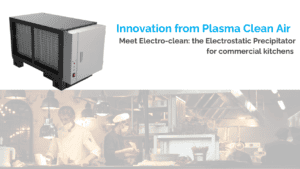
If you have a metal box installed within your kitchen extract ductwork labelled ESP or Electrostatic Precipitator, its primary job is to remove very fine grease and smoke particles.
An ESP uses an electrical charge to capture particles as the kitchen extract air passes through it.
You don’t need to understand the electrical process to operate the kitchen. The simplest way to think about an ESP is as a highly efficient filter for the very small particles that ordinary grease filters struggle to catch.
This makes ESPs particularly useful for kitchens producing significant quantities of grease and smoke, including chargrills, wok cooking and other high-output cooking operations.
Plasma Clean Air’s Electro-clean ESP, for example, is designed to capture up to 95% of smoke and grease particles.
However, there is one important limitation:
An ESP doesn’t remove gaseous cooking odours.
If odour control is also required, the ESP will normally form one stage of a wider grease, smoke and odour control system.
What Maintenance Does An ESP Need?
The collector cells inside an ESP gradually become contaminated with the grease and particles they remove from the air.
They therefore need to be removed and professionally cleaned.
As a general guide, maintenance may be required every two to four months, although the actual frequency depends on cooking type, operating hours and grease loading.
If you’ve inherited an ESP and don’t know when it was last serviced, having it inspected is a sensible starting point.
UV Systems – Grease and Odour Control
UV kitchen filtration systems can be installed either inside the kitchen canopy or within the extract ductwork.
Rather than simply trapping contaminants on a filter, UV systems are designed to break down grease vapours and gaseous cooking odours.
One of the major advantages of Canopy Mount UV is that treatment begins close to the cooking source. This can be particularly useful where plant space elsewhere in the building is limited.
Reducing the amount of grease entering the ductwork can also help reduce grease accumulation and associated fire risk while lowering the load on downstream filtration equipment.
UV systems also generate ozone, which continues reacting with cooking odours as the extract air travels through the ductwork.
Plasma Clean Air describes this combination of UV light and ozone as a means of treating both grease and gaseous odour.
Ozone Injection – Treating Cooking Smells
An ozone injection system is primarily an odour control technology.
Unlike an ESP, it isn’t designed to physically capture grease or smoke.
Instead, ozone is introduced into the kitchen extract ductwork where it reacts with the compounds responsible for cooking smells, helping reduce the level of odour before the air reaches the extract discharge.
One advantage is that the ozone-generating equipment can be mounted outside the main airflow, making it an easy retrofit option with no additional pressure drop through the unit itself. This means that you don’t need to consider a fan upgrade when installing this type of equipment.
Ozone systems work best as part of a staged filtration arrangement and should have good grease filtration upstream, for example an electrostatic precipitator (ESP) as mentioned earlier in the article. If ozone injection or in-duct UV is placed before an ESP, the chances are that the UV lamps will get dirty very quickly which reduces their performance.
What Maintenance Does Ozone Equipment Need?
Plasma Clean Air recommends an annual service to maintain performance and safe operation.
The effectiveness of the system also depends on its design. The ozone needs sufficient time to react with the cooking odours before the extract air leaves the building.
For this reason, an existing ozone system should be assessed as part of the complete ventilation system rather than simply checking whether the unit switches on.
Activated Carbon – Capturing Gaseous Odours
Activated carbon filtration is another widely used method of commercial kitchen odour control.
Carbon has an enormous internal surface area that captures, or “adsorbs”, gaseous odour molecules as air passes through it.
It can be used as the main form of gaseous odour control or alongside UV or ozone equipment. It can also help remove surplus ozone before the kitchen extract air is discharged.
But carbon has an important weakness:
It doesn’t like grease.
If activated carbon is exposed to grease and particulates, it can become contaminated and its useful life can be significantly reduced.
Good upstream filtration is therefore essential. This could include Ecofleece filters, an ESP or suitable panel and bag filtration.
What Maintenance Does Activated Carbon need?
Activated carbon cannot simply be washed and reused indefinitely. Once it becomes spent, it needs replacing.
As a broad guide, carbon used as the primary odour control method may require replacement approximately every four to six months.
Where carbon is used in combination with UV or ozone, replacement intervals may extend to approximately nine to twelve months.
These are guides rather than fixed rules. Cooking type, hours of operation and the amount of grease reaching the carbon all affect its life.
Panel, Bag and HEPA Filters – Different Filters for Different Jobs
You may also find more conventional filters within a commercial kitchen filtration system.
Panel filters capture larger particles and can provide additional protection for equipment further downstream.
Bag filters capture finer grease particulates and are often used to protect activated carbon or other odour control equipment.
HEPA filters provide very high-efficiency particulate filtration and can be used for fine smoke particles where additional particulate control is required.
Again, none of these should automatically be regarded as an odour filter. A HEPA filter may be extremely efficient at capturing tiny particles, but gaseous cooking odours are not particles.
That’s why understanding what you are trying to remove is so important.
Recirculation Systems – When You Can’t Extract Directly Outside
Most commercial kitchens should, where practical, use a properly designed extract system that discharges outside with appropriate filtration.
Occasionally this isn’t possible.
In these situations, a commercial kitchen recirculation system may be considered.
Plasma Clean Air’s RECIRC systems use multiple filtration stages including panel, bag, HEPA and activated carbon filters to progressively remove grease, smoke and gaseous odours.
There are important limitations, however.
Recirculation systems are suitable only for all-electric kitchens, and adequate kitchen cooling and general ventilation still need to be considered.
They should therefore be professionally designed rather than treated as a simple alternative to installing an extract duct.
Why Are Several Types of Kitchen Filtration Often Installed Together?
This is probably the most important point for an end user to understand.
You might open your plant room and discover an ESP, UV unit and activated carbon filters all installed one after another.
That doesn’t necessarily mean the original designer overcomplicated the system.
Each piece of equipment may be doing a different job.
For example:
Stage 1 – Ecofleece: removes grease at the canopy.
Stage 2 – ESP: captures remaining fine grease and smoke.
Stage 3 – UV or ozone: treats gaseous cooking odours.
Stage 4 – Activated carbon: provides final odour control and can remove residual ozone.
This staged approach to ventilation is particularly important for kitchens producing high levels of grease, smoke and odour.
Plasma Clean Air’s guidance similarly recommends removing grease and smoke first where possible, reducing the load placed on downstream odour treatment equipment.
Why Does the Type of Cooking Matter?
There is no universal filtration system that is right for every commercial kitchen.
A bakery reheating food has very different requirements from a steakhouse operating a chargrill all day.
Wok cooking, chargrilling, frying and solid-fuel cooking can create particularly demanding grease and smoke loads. Plasma Clean Air’s guidance, for example, categorises chargrill and solid-fuel applications among the higher grease, smoke and odour-producing operations.
Location matters too…
A kitchen extracting at high level in an isolated location presents a different odour risk from a restaurant with flats directly above it and opening windows close to the extract discharge.
This is why local authorities may require an odour risk assessment and suitable commercial kitchen odour control as part of a planning application.
Plasma Clean Air works with operators, consultants, contractors and local authorities to specify filtration in line with recognised EMAQ+ and DW/172 guidance.
I’ve Inherited Kitchen Filtration Equipment – What Should I Do?
If you’ve moved into an existing commercial kitchen, don’t assume that the filtration equipment is operating correctly simply because the extract fan works.
Try to establish:
- What filtration equipment is installed?
- What is each piece of equipment designed to remove?
- When was it last serviced?
- Are replacement filters, carbon or UV lamps overdue?
- Has your cooking operation changed since the system was originally designed?
- Is there an operation and maintenance manual?
- Is the kitchen experiencing smoke or odour complaints?
- Is grease accumulating excessively within the extract ductwork?
A professional inspection can identify the equipment, assess its condition and establish an appropriate planned preventative maintenance programme.
Plasma Clean Air services ESPs, UV systems, activated carbon and fine filtration, including equipment supplied by other manufacturers.
Planning a New Commercial Kitchen?
If you’re at the design or planning stage, consider grease, smoke and odour filtration early.
Leaving it until the kitchen and ventilation system have already been designed can create problems because filtration equipment needs sufficient space, suitable ductwork and appropriate access for maintenance.
The filtration requirement should take account of the cooking equipment and menu, extract airflow, grease and smoke loading, proximity of neighbouring properties, location of the discharge and available plant space.
Early consideration can result in a simpler, more effective and easier-to-maintain system.
The Simple Rule: Grease, Smoke and Odour Are Different Problems
Commercial kitchen filtration doesn’t need to be confusing.
Start by remembering three things:
Grease needs to be captured or treated. Smoke particles need to be removed. Gaseous odours need separate treatment.
The best commercial kitchen filtration systems therefore use the right combination of technologies for the cooking operation and location.
Just as importantly, every system needs appropriate maintenance. Filters become dirty, ESP cells require cleaning, UV lamps age and activated carbon eventually becomes spent.
Understanding what your equipment does – and maintaining it properly – helps your commercial kitchen ventilation system continue to control grease, smoke and cooking odours while reducing grease accumulation, protecting downstream equipment and helping minimise complaints and fire risk.
Need Help Understanding Your Existing Kitchen Filtration?
If you’ve inherited a commercial kitchen filtration system and aren’t sure what the equipment does, Plasma Clean Air can help explain the installation, identify the filtration stages and recommend an appropriate servicing and maintenance programme.
If you’re planning a new kitchen, we can also help assess the expected grease, smoke and odour load and recommend a filtration strategy appropriate to your cooking operation, kitchen ventilation system and location.
Speak to Plasma Clean Air about commercial kitchen grease, smoke and odour control, filtration equipment servicing or an odour control assessment.
Get In Touch
Please leave your information and our team will contact you shortly!