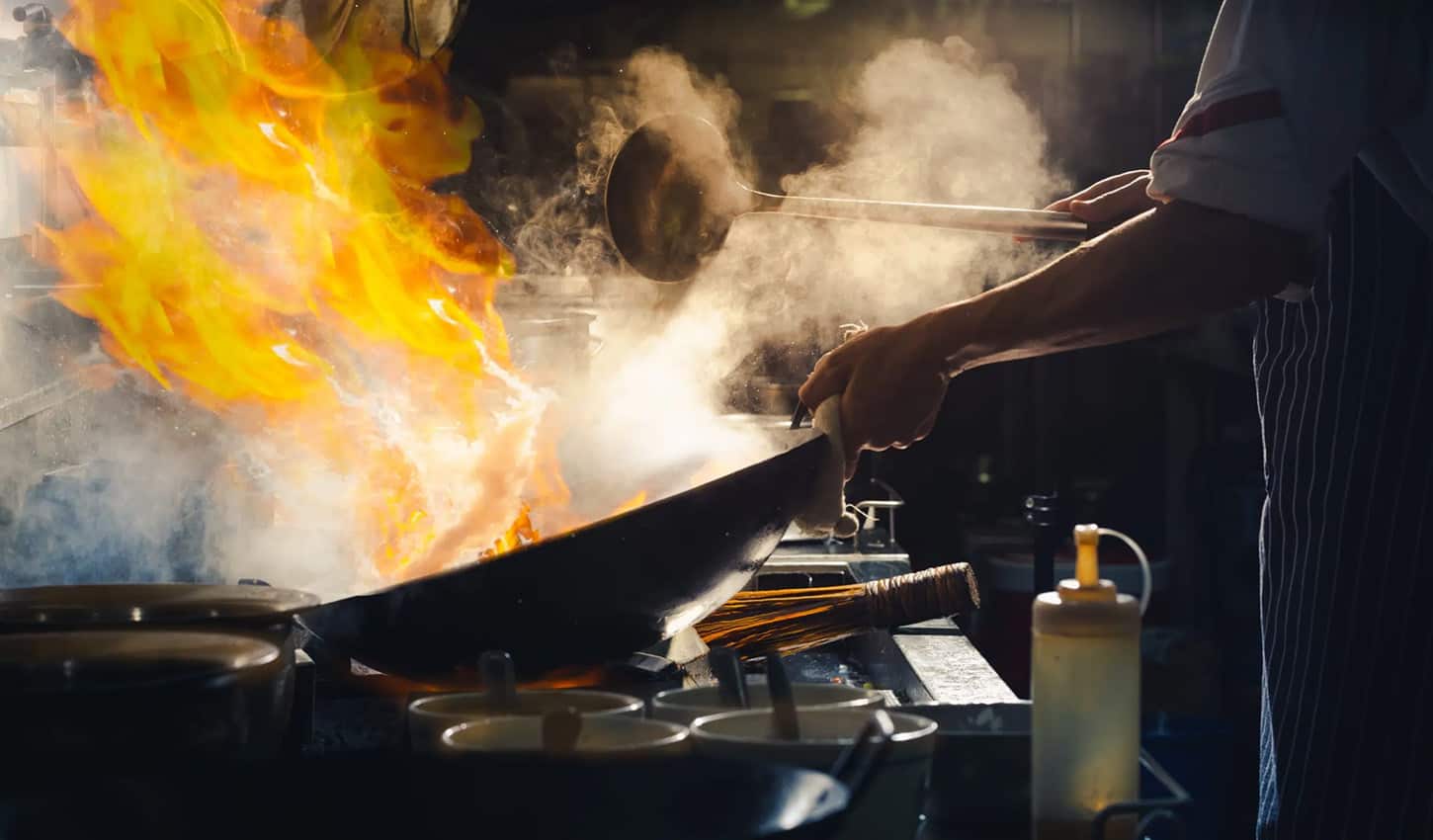
When you cook, the heat and steam rising from the hob are easy to see. What is less obvious is the grease, fine smoke particles and cooking odours travelling with them into your kitchen extraction system.
Your canopy and extract fan take these fumes away from the cooking area. Depending on what you cook and where the air leaves the building, you may also need equipment to remove grease, capture smoke and treat cooking smells before they reach your neighbours.
If you have inherited a kitchen with filtration equipment already installed, you may know that it needs servicing without being entirely sure what each unit does. Or perhaps you are planning a new restaurant and have been told that your extraction system needs to meet EMAQ guidance.
This article explains the connection between the two, and what the updated EMAQ 2026 guidance means for commercial kitchen grease, smoke and odour control.
Why kitchen extraction needs more than a fan
Think about the difference between boiling vegetables and cooking burgers on a chargrill. Both need extraction, but the amount of grease, smoke and odour they produce will be very different.
Some grease is caught by the filters in the canopy. Smaller droplets and smoke particles can travel further into the system, where they may collect on ductwork and fans or leave the building in the extract air. Cooking smells can also pass through filters that are designed to catch particles.
This is why commercial kitchen filtration often involves several pieces of equipment working together. Each has a particular job, and the combination needs to suit your cooking operation.
Removing grease helps keep the extraction system cleaner and reduces the material available to fuel a duct fire. Capturing smoke helps control the particles released outside. Treating gaseous odours helps reduce the impact of cooking smells on neighbouring homes and businesses.
The location matters too. A restaurant with flats directly above it and opening windows close to the extract outlet presents a different challenge from a kitchen with a suitable high-level outlet well away from neighbouring properties.
What the different filtration units do
You do not need to understand every detail of the equipment to understand the basic approach.
Grease filters provide the first stage of protection at the canopy. Further along the extraction system, an electrostatic precipitator, usually shortened to ESP, can capture fine grease and smoke particles that have passed through the canopy filters.
Gaseous cooking odours need a different treatment. Activated carbon captures odour compounds as air passes through it. UV and ozone systems use a chemical reaction to break down odour compounds, with the arrangement depending on whether treatment starts in the canopy or further along the ductwork.
For many installations, the principle is to remove grease and smoke first, then treat the remaining gaseous odours. This also helps protect the odour control equipment. Carbon filters, for example, can quickly lose effectiveness if they become coated with grease.
We explain the individual technologies in more detail in our commercial kitchen filtration explained guide.
Where EMAQ guidance fits in
EMAQ+ guidance ‘The Control of Odour and Noise from Commercial Kitchen Exhaust Systems’ helps local authorities, kitchen designers, consultants and operators assess the effect of commercial kitchen extraction on the surrounding area. It covers odour and noise, the equipment used to control emissions, and the maintenance needed to keep systems working.
If you have heard this referred to as DEFRA kitchen extraction guidance, the original document was withdrawn in 2017 and EMAQ+ subsequently published updated guidance in its place.
The latest EMAQ+ edition was published in May 2026. It builds on the earlier editions, with greater attention to fine particles from cooking and more explanation of how filtration should be selected for different situations.
For someone running a kitchen, its value is practical. It helps establish how much odour control is needed, taking account of what you cook, the scale of the operation, nearby properties and how effectively the extract air can disperse outside.
It is technical guidance rather than legislation in its own right. Your particular planning conditions and local authority requirements still need to be considered although to a large extent local authority Environmental Health Officers use the EMAQ+ guidance when it comes to planning and enforcement.
What has changed in the 2026 EMAQ guidance
One of the main updates is the increased focus on PM2.5. This means very small airborne particles, measuring 2.5 micrometres or less, which can be produced during cooking.
You do not need to see a smoky plume for fine particles to be present. The updated guidance explains more about how cooking produces these emissions and includes published research covering different foods, oils and cooking methods.
For kitchen operators, this reinforces the importance of explaining what actually happens in the kitchen when a system is being assessed. A change from light cooking to regular frying or chargrilling can change the filtration requirement, even if the premises and extract fan stay the same.
It also means that a suitable high-level outlet may still need additional grease and smoke filtration, depending on the cooking activity and local authority policies on fine particulate emissions.
A clearer explanation of ESP performance
The new edition includes additional information showing how ESP particle collection changes with airflow and particle size.
In straightforward terms, an ESP needs enough capacity to treat the air passing through it. Push too much air through a particular unit and its ability to capture particles can fall.
This is why a quoted efficiency figure needs some context. The useful question is how the equipment performs at the airflow and in the arrangement proposed for your kitchen. A busy chargrill may need a different configuration from a kitchen producing lighter grease and smoke loads.
Our Electro-clean ESP is used to remove fine grease and smoke as part of a wider filtration system. Where gaseous odour control is needed, a suitable treatment stage is also required.
More detail on UV and ozone systems
The updated guidance gives more explanation of UV and ozone treatment, including where lamps are positioned, how they are maintained and how much time the treatment has to work.
That last point is important. Introducing ozone into an extraction system does not mean the cooking smells disappear immediately. The treatment needs sufficient time to react with the odour compounds before the air leaves the building. This is known as the contact time or dwell time and is measured in seconds.
The guidance distinguishes between ozone-only treatment and combined UV-C and ozone systems, which can have different reaction-time requirements. It also explains that oxidation treatment has limitations for smoke particles containing material that is already oxidised.
Any ozone remaining in the air also needs consideration. Depending on the discharge arrangement, additional treatment, such as a suitable carbon stage, may be needed.
You can read more about our UV-C and ozone systems for kitchen extract.
More examples of kitchens in difficult locations
The additional case studies are useful because buildings and their surroundings do not always fit neatly into a standard assessment.
For example, an extract outlet may be above the restaurant roof but still close to the height of a neighbour’s garden on rising ground. Air released into a confined courtyard may have little opportunity to disperse before reaching a window or ventilation intake.
The guidance also considers large central production kitchens, where the volume of cooking can exceed that of a typical restaurant.
The basic odour risk scoring remains unchanged. The new examples explain where professional judgement is needed to account for circumstances that the standard scores may not adequately represent. If you are in the process of planning a new kitchen or refurbishment, get in touch and we can provide you with a free EMAQ+ Odour Risk Assessment.
What still matters when selecting kitchen odour control
The updated guidance continues to support an approach that considers the complete system, from canopy to extract.
The canopy needs to capture the fumes effectively. The fan needs to deliver the required airflow through the ductwork and filtration equipment. The outlet location and noise from the system also need consideration.
Activated carbon needs enough contact time with the air to remove gaseous odours effectively. A small carbon filter handling a large airflow may provide insufficient treatment, particularly where cooking odours are strong or dispersion outside is poor. Our activated carbon and fine filtration options can be selected as part of a system suited to those conditions.
These principles sit alongside the design standards referenced in the guidance. The 2026 edition carries forward earlier amendments, including references to BS EN 16282 introduced in 2022, so not every difference from the 2018 version is a new change this year.
Maintenance keeps the equipment doing its job
A kitchen extract fan can be running while the filtration equipment is no longer working effectively.
ESP cells become loaded with grease, UV ozone lamps get dirty and age, and activated carbon eventually needs replacing. If those tasks are missed, smoke and odour control can deteriorate even though air is still being extracted from the kitchen.
The current EMAQ guidance emphasises inspection, cleaning and documented maintenance, including photographs and recommendations where better access is needed. Service intervals should reflect the equipment, cooking load and actual condition of the system.
Equipment servicing also needs to be coordinated with managing grease accumulation in the canopy and ductwork. Our TR19 guide for commercial kitchen operators explains how TR19® Grease supports inspection, cleaning and reporting.
What this means for your kitchen
For an existing kitchen, start by checking what equipment is installed, when it was last serviced and whether the cooking operation has changed since the system was designed.
For a new project, consider filtration early. Allowing plant space for the equipment and access for maintenance is much easier before the kitchen layout and duct route have been finalised.
At Plasma Clean Air, we help with grease, smoke and odour control equipment and the ongoing maintenance needed to support its performance. Our commercial kitchen ventilation maintenance brings equipment servicing, TR19® Grease inspections and ductwork cleaning into one coordinated approach, from canopy to extract. We also service equipment from other manufacturers.
Bringing these activities together can reduce duplicated visits and make maintenance easier to manage. Read why bundling ventilation services saves time and money, or contact Plasma Clean Air to discuss your kitchen extraction system.
Get In Touch
Please leave your information and our team will contact you shortly!